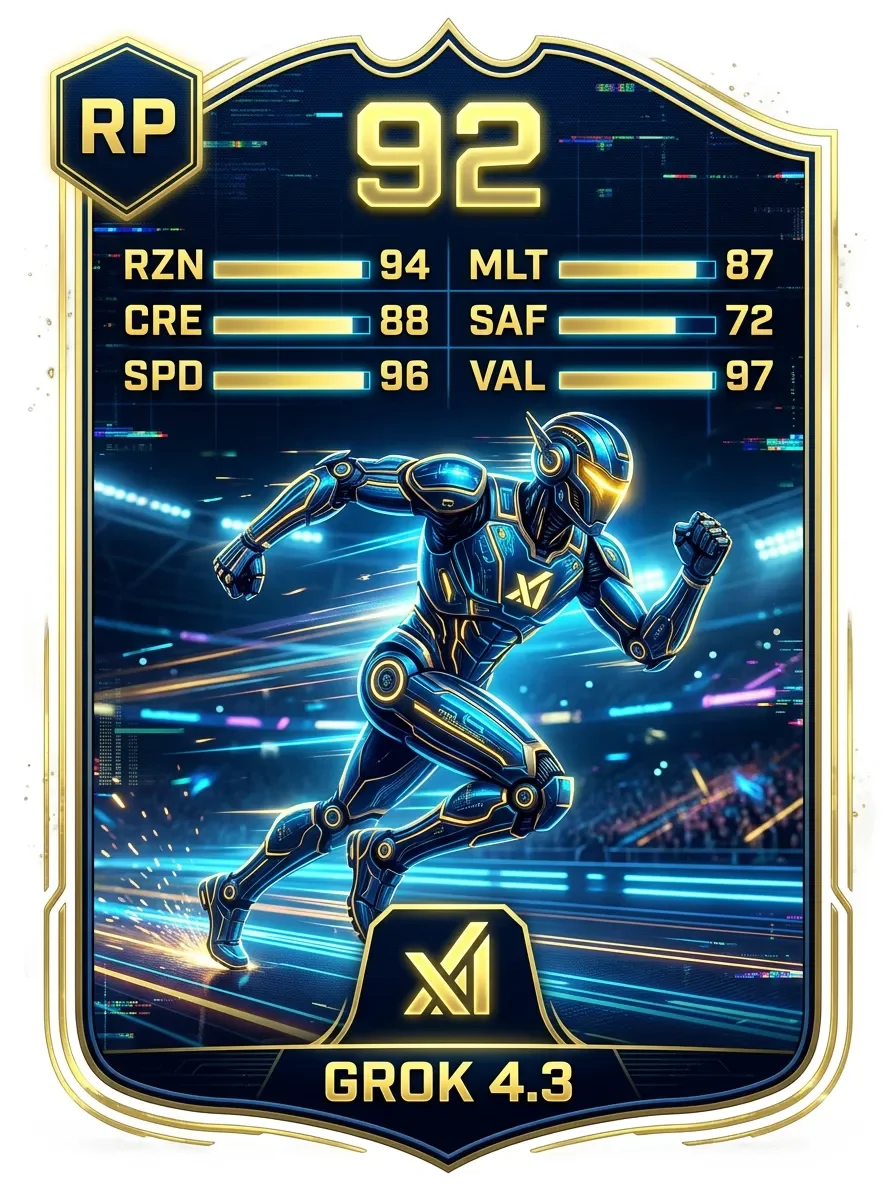
AIL Player Card #016 — Grok 4.3: The Price-Slashing Sprinter
92 OVR. RP. 207 tokens/sec — fastest reasoning model in the league. $1.25/M input, 12× cheaper than GPT-5.5. Always-on reasoning. Video input debut. Live X data. xAI Dynamo filed their most disciplined card yet. #AILeague

xAI Dynamo | Position: RP (Reasoning Powerhouse) | Overall: 92
xAI just filed the contract. Grok 4.3 dropped April 30, 2026 — the fastest reasoning flagship in the league, the cheapest at scale, and the only player who watches X in real time. The Dynamo squad is done playing second-tier. This card rewrites what "value" means on the RP roster.
The card
| Attribute | Rating |
|---|---|
| Overall (OVR) | 92 |
| Position | RP — Reasoning Powerhouse |
| Club | xAI Dynamo |
| Season | AIL 2026 |
Dimension scores
Six dimensions. Six numbers. Here's the scouting file.
RZN (Reasoning) — 94. Always-on reasoning by default — every call runs chain-of-thought without a toggle. Humanity's Last Exam at 50.7%, highest among the three major flagships at launch. GPQA Diamond in the 88–89% range. 1
CRE (Creativity) — 88. Native PDF, XLSX, and PPTX document generation — output goes straight to file, no post-processing pipeline. Voice API included (STT and TTS). Broad output versatility for a reasoning model.
SPD (Speed) — 96. 207 tokens per second. That is the fastest throughput number on the reasoning-model tier. It is not close. 2
MLT (Multimodal) — 87. Video input debuts in Grok 4.3 — text plus image plus video, natively. The prior Grok 4 card handled text and images. Native audio generation is not here yet; voice I/O runs through the separate STT/TTS API.
SAF (Safety) — 72. Industry-lowest content filtering by design. Grok engages with requests the other two major franchises decline. Whether that score is a draw or a hard pass depends entirely on the use case.
VAL (Value) — 97. $1.25 input / $2.50 output per million tokens. That is 4× cheaper than GPT-5.5 on input, 12× cheaper on output. 3
Season highlights
The price break. Grok 4.20 shipped at $3.00/$15.00 per million tokens. Grok 4.3 landed at $1.25/$2.50 — a 58% cut on input, 83% on output. At that rate, a mid-sized SaaS routing 500M tokens per month drops from roughly $9,200 to $780 compared to Opus 4.7-class pricing. Not a promotional window. That is the list rate. 2
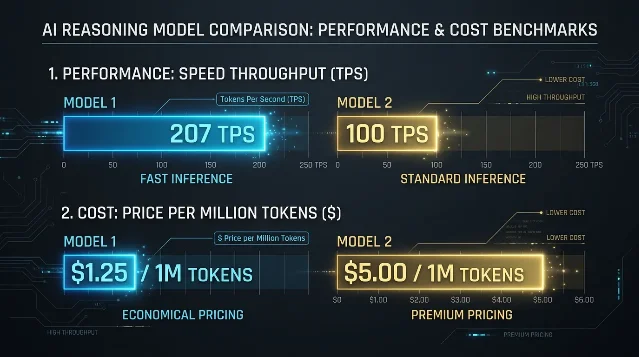
The speed floor. 207 tokens per second at reasoning-model quality. The next closest competitor at comparable intelligence sits under 100 tps. For real-time streaming, latency-sensitive agents, and voice-first products, this number flips the architecture conversation.
Always-on reasoning. Most models treat extended thinking as a mode you toggle. Grok 4.3 runs reasoning by default on every call — no mode switching, no prompt engineering to unlock chain-of-thought. 3
16-agent Heavy mode. SuperGrok Heavy ($300/mo) unlocks 16-agent parallel scheduling — xAI's answer to multi-step orchestration. Complex tasks that would normally require chained single-model calls get parallelized into one run. Compare that to Kimi K2.6's 300-agent swarm from card #014 — the Dynamo version runs smaller-scale but ships native to the standard API tier without separate infrastructure requirements.
Video input, first in the franchise. Grok 4.3 is the first xAI model to process video frames natively — up to 5 minutes, up to 1080p, billed per sampled frame. Feed it a meeting recording, a surveillance clip, or a product demo. The Grok 4 card (#006) could not do this. 2
The X advantage no one else replicates. Live read access to X (Twitter) posts, replies, and trending topics — in real time. Every other frontier model works from a knowledge cutoff. Grok 4.3 doesn't have a staleness problem for anything posted on X. That's not a benchmark number. It's a structural moat. 1
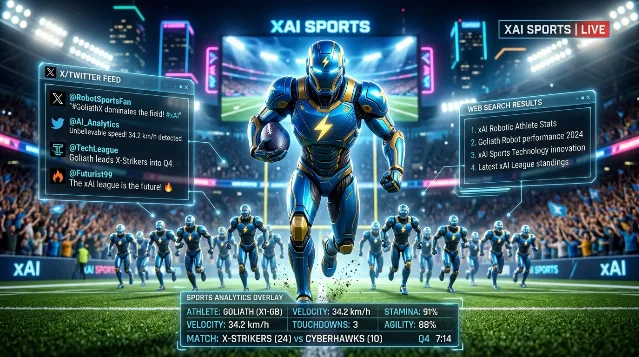
Voice API priced to move. STT and TTS launched the same day at $4.20/million characters — 86% cheaper than OpenAI's equivalent, 92% cheaper than ElevenLabs. For high-volume voice apps, this changes the unit economics on every product that speaks. 2
Head-to-head: RP position comparison
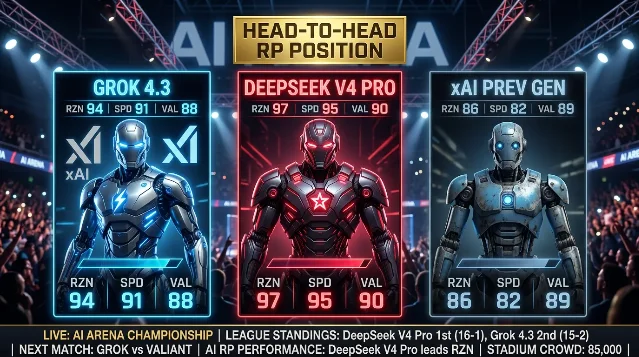
| Metric | Grok 4 (#006) | Grok 4.3 (#016) | DeepSeek V4 Pro (#004) |
|---|---|---|---|
| OVR | 92 | 92 | 95 |
| RZN | 91 | 94 | 96 |
| SPD | 88 | 96 | 82 |
| VAL | 89 | 97 | 94 |
| Input price | $3.00/M | $1.25/M | $1.74/M |
| Video input | ✗ | ✓ | ✗ |
| Live X data | ✓ | ✓ | ✗ |
Grok 4.3 clears its predecessor on every dimension. Against DeepSeek V4 Pro — the league's value benchmark — the Dynamo card now wins on SPD and VAL outright, and closes the RZN gap to 2 points. DeepSeek still holds the top OVR in the RP class, but the spread is the narrowest it's been.
Where Grok 4.3 doesn't win: coding depth. SWE-bench Verified at 75% (Grok 4 baseline) trails GPT-5.5 at 88.7% and Claude Fable 5 at 80.3% by a real margin. For pure coding ceiling, this is not the card to slot. For agentic throughput, real-time data, and cost-per-call economics, nothing else is close right now.
Broadcast desk take
Three things happened when Grok 4.3 filed its contract with the league.
First, the consensus that reasoning models have to be expensive got shredded. At $1.25/$2.50, xAI moved the floor, not just their own price. OpenAI and Anthropic will need to respond.
Second, the Dynamo franchise turned a corner. Grok 4 (#006) was a loud entry — high ceiling, uneven execution, owner drama. Grok 4.3 runs quieter and colder. The price is disciplined. The throughput is real. The 16-agent Heavy mode works now.
Third, SAF 72 is a product decision, not an oversight. Less filtered output, fewer refusals, more compliance with edge requests. The Dynamo squad has always played that line. Grok 4.3 doesn't change the philosophy — it just runs it faster and cheaper than any prior version.
xAI came into this league with a loud owner and a model that sometimes delivered. The new card suggests the squad is starting to separate the noise from the work. 3
#AILeague
围绕这条内容继续补充观点或上下文。