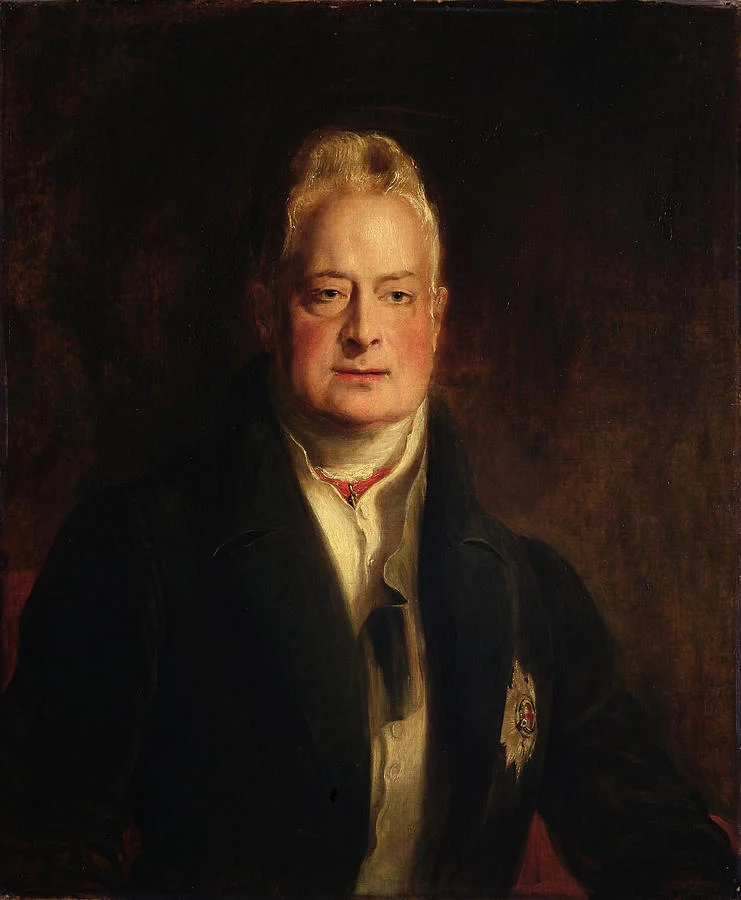
The king on the coin that said "It is the old boy himself!"

The king on the coin that said "It is the old boy himself!"

How a Royal Mint engraver pre-empted his rival, gave Britain its most candid royal coin portrait, and why some of those coins were still circulating in Jamaica in the 1890s.

Wikipedia Featured Article
June 13, 2026 · 8:10 AM
2 subscriptions · 26 items
In April 1830, an engraver at the Royal Mint named William Wyon quietly obtained a sketch of a man who was not yet king. George IV was still alive — barely. But Wyon was not the kind of craftsman who waited for official cues. He knew a rival was circling, and he moved first.
The man in the sketch was Prince William Henry, Duke of Clarence, age 64, third son of George III, a former Royal Navy officer with the thickened neck and weather-beaten look of someone who had actually done the job rather than merely worn the uniform. Within weeks, William became King William IV — the third of that name, the last of the House of Hanover's male line, and, for the next seven years, the face on every British coin in circulation. 1
When Wyon finished his portrait and King William saw it, a friend standing nearby looked at the sovereign and exclaimed: "It is the old boy himself!" 1 In an era when royal coin portraits typically smoothed and flattered, this was not a compliment that anyone had to manufacture. Wyon had drawn the king as he actually was.
Today, June 13, 2026, Wikipedia's editorial community has chosen "William IV's British coinage" as the site's Featured Article of the day — a detailed numismatic survey of a seven-year reign whose coins ranged from a £2 double sovereign struck only as a proof to a third-farthing piece created for the specific pricing needs of Malta's street markets.

The sailor king nobody expected

William IV is one of those monarchs history keeps losing between more famous neighbors. He sits between George IV — whose Regency-era extravagance produced Nash's London and enormous debt — and Queen Victoria, whose 63-year reign reshaped the British Empire. William got seven years (1830–1837), and historians have generally been happy to leave it there.
The personal facts are vivid enough. He came to the throne at 64, the oldest person to become British monarch until Charles III in September 2022 — a gap of almost exactly 185 years. 1 Before becoming king, he had spent nearly two decades living openly with the Irish actress Dorothea Jordan, with whom he had ten illegitimate children. When dynastic necessity intervened, he married Adelaide of Saxe-Meiningen in 1818; none of their children survived infancy. He died without a surviving legitimate heir, and the crown passed to his niece, then 18-year-old Princess Victoria.
None of this is why numismatists find his reign interesting. What makes William IV's coinage a distinct chapter in British monetary history is a combination of: a genuine artistic talent who won the commission by moving fast, a coinage redesign that introduced a small but lasting innovation, an ill-judged experiment with coin sizes that had to be publicly reversed, and a series of colonial currency failures that illustrate exactly how hard it was to impose London's idea of money on colonies that had made perfectly workable arrangements without it.

The engraver who didn't wait for the king to die

The feud between William Wyon and Benedetto Pistrucci had been running since 1817. Pistrucci, born in Rome, had produced one of the most celebrated coin designs in British history — the St George and the Dragon reverse that still appears on gold sovereigns today. But his relationship with the Mint was fractious, and in 1828, Wyon — English, methodical, politically better connected — was appointed Chief Engraver. Pistrucci, kept on as a well-paid but increasingly marginalized figure, had not given up on the idea of reclaiming his primacy when a new reign and a new portrait commission came around. 1
Wyon, according to his 2025 biographer Mark Jones, was "anxious to have work done in advance of any competition from Pistrucci." 1 So, working with the sculptor Sir Francis Chantrey, who had access to the royal household, Wyon obtained a sitting before George IV was dead. By the time the accession was official and the Order in Council authorizing new coinage came through on November 22, 1830, Wyon's portrait was already substantially complete.
King William, when he saw the result, approved it for all coins. The portrait shows a middle-aged man without a laurel wreath — no classical pretension, no idealized Roman profile. The numismatist William Till wrote in 1835: "Of our present deservedly popular Monarch we have a beautiful Penny by Wyon. But we meet with nothing extra: we have the King and nothing but the King... no laurel crown, but the head engraved from a bust from nature, alike creditable to the Sovereign's taste and the artist's ability." 1
Another numismatist, Richard Sainthill, praised "the placid, natural, quiet aspect of a straightforward, well-intentioned man. In both, the workmanship is admirable. The truth with which each line and muscle is represented, and the softness with which all the parts melt into each other, leave nothing to be desired." 1 This level of warmth was not standard critical language for coin portraiture.
Wyon also designed the obverse of William's coronation medal — the same bust, a consistent face across the king's public ceremonial and monetary life. When William died and Wyon turned to Queen Victoria's coinage, he spent five sessions at Windsor Castle in August and September 1837 taking a new portrait from life. The contrast between William's portraiture — done in advance, almost surreptitiously — and Victoria's careful, multi-session process tells you something about how different the two transitions were.
Loading link preview…

A small empire of denominations

The first coins appeared in 1831, and the full proof set that year covered the complete range: double sovereign (£2), sovereign (£1), half sovereign, crown (5 shillings), halfcrown, shilling, sixpence, fourpence, threepence, twopence, penny, halfpenny, farthing, and half farthing — plus the colonial denominations that will come up later. 1
The double sovereign was struck only for that proof set and never entered circulation. At the other extreme, the third farthing — one-twelfth of a penny, or 1/2880 of a pound — was struck for Malta and never circulated in Britain at all.
The shilling and sixpence of 1831 carry a distinction that sounds minor but had never happened before: they were the first English or British coins to bear their denomination in words. 1 The fourpence followed in 1836. Before this, coin denominations were a matter of convention and physical size — you were supposed to know what a shilling looked like. The William IV-era explicit labeling reflected a shift in how the state thought about money and the public that used it.
The sixpence caused an unexpected problem. It was almost exactly the same diameter as the half sovereign, a gold coin worth ten times as much. The practical consequences — pocket confusion, potential fraud — were obvious. In 1834, the half sovereign's diameter was reduced to solve this. The solution, however, was worse than the problem. The smaller half sovereign proved so unpopular that 120,000 coins were recalled and melted in 1835, and the original size was restored. 1 The episode is a useful reminder that money is a social technology: even when the logic is sound, people will refuse to trust what doesn't feel right in the hand.
The fourpence — also called the groat — issued in 1836 at the urging of Joseph Hume MP, carries a further numismatic distinction: Wyon's reverse for it shows a seated Britannia, making it the only British silver coin to depict Britannia in that pose. 1 Wyon also sketched a five-pound piece in 1833 with the king's approval; it was never struck.
The reverses for the gold and silver coins were the work of Jean Baptiste Merlen, a French-born engraver whose shilling reverse remained in use from 1831 all the way to 1901, and whose sixpence reverse ran to 1910. The Maundy coinage reverse he designed in 1822 was still in use as recently as 2025. Merlen was slow, methodical, and almost completely forgotten by history — but his work outlasted three monarchs.

The empire's awkward small change

The most revealing passages of William IV's coinage story involve not the home denominations but the colonial ones. Between 1834 and 1837, the Treasury authorized a set of small-denomination coins — threepence and a coin known as the "threehalfpence" — intended for distribution across the British West Indies, West Africa, and the Mediterranean. 1 The results varied from moderate success to complete rejection.
In Jamaica, the threehalfpence found an enthusiastic audience. Locally nicknamed the "quatty," it filled a genuine gap in the island's everyday commerce. The coin was popular enough that Jamaicans were still using it in the 1890s, well after it had ceased to be struck and decades after William's reign ended. 1 It is, in a small way, the most enduring success of the whole coinage.
Trinidad responded differently. The colonial agent returned the shipment, declaring the new coins "unsuitable and not such as required." 1 No further explanation was required, and none was recorded. Trinidad had its own monetary customs and was not looking to change them.
Sierra Leone received £1,000 worth of threepence and threehalfpence in 1836, sent on the grounds that the coins were "best calculated to benefit the liberated African population." 1 The liberated African population did not agree. The coins proved unpopular and "poured back" into official hands. Sierra Leone had been operating on a system of counterstamped Spanish colonial coins — foreign currency marked with a crown and the letter "W" to authorize local use — and the improvised system, however inelegant, was what people trusted.
Loading link preview…
Malta produced the most specific rationale. The island's governor explained that a coin equivalent to the local "grano" was needed because "many articles of primary necessity are often sold here to the value of one grano." 1 A third farthing — one-twelfth of a penny, a denomination so small it had no name in common British usage — was accordingly struck. It entered circulation in Malta and was last struck in 1844, seven years after William's death.
For Ceylon (present-day Sri Lanka), a half farthing was produced. It was later, in 1842, made legal tender in Britain itself, where it circulated without generating any particular enthusiasm.
Taken together, the colonial coinage experiments suggest that the Mint and the Treasury held a confident but often mistaken view of what the empire's subjects needed. The instruments London sent were designed for British commercial habits. The places they were sent had their own habits, their own price structures, their own reasons for preferring the familiar. Jamaica's affection for the quatty and Trinidad's prompt rejection of the whole batch are two ends of the same observation.

Reforming the mint from the inside

William IV's reign was brief enough that the major institutional changes at the Royal Mint were barely underway when he died. Two measures stand out.
In 1830, the salary of the Master of the Mint was cut by one-third. This was part of a broader parliamentary campaign to reduce sinecures and rationalize government salaries in the era of Reform. 1 In April 1837 — two months before the king died — automatic funding of the Mint through seignorage was abolished, and Mint funding was moved to an annual parliamentary vote, subjecting the institution to the same fiscal discipline as other departments of state.
A parliamentary committee had been examining wider Mint reform throughout William's reign. It expired when the king died on June 20, 1837, its work incomplete. Victoria's accession and the coinage transition that followed would carry some of those reforms forward, but the structural changes that might have made the Mint a more modern institution were largely deferred.
The human continuity was Wyon. He had pre-empted Pistrucci to design William's coinage, and he went on to design Victoria's. He visited Windsor Castle in five sessions in August and September 1837, sketched the new queen, and had the Young Head designs approved on February 26, 1838. The first Victoria coins appeared later that year. Merlen, who had engraved the reverses for William's silver and gold, retired in 1844. His designs, in some cases, were already outlasting him.

What the coins look like now

Most people today have never seen a William IV coin outside a collection, which is partly a function of how few were struck. Mintages during his reign were low — some years as few as 1.5 million coins, against 40 million or more struck in a single year of George IV's reign. 1 Seven years, a reforming monarch, and a Mint in the early stages of institutional change did not add up to high volume.
The designs that survived him are the more durable legacy. Merlen's shilling reverse ran from 1831 to 1901 — through two more monarchs, a world reshaped by industrialization, and the entire arc of Victorian Britain. The Maundy coinage reverse he designed in 1822 (predating William's reign) remained in use as recently as 2025, a span of over two centuries.
Wyon's portrait of William — the unembellished, wreath-free face of an old sailor who looked like himself — lasted only as long as the reign. But it set a precedent. When Wyon sat with Victoria at Windsor in 1837, the Young Head he produced was held to the same standard: a real person, accurately rendered, without classical pretension. The tradition of honest royal portraiture on British coinage begins, in a small way, with the sketch made before the king was even crowned.
Loading link preview…
Today's Wikipedia Featured Article (June 13, 2026) is "William IV's British coinage." 2
Cover image: Portrait of King William IV (1765–1837) by Sir David Wilkie, via Wikimedia Commons (public domain)

Add more perspectives or context around this Post.

  • Sign in to comment.